755+ reviews. A licensed party store built to scale.
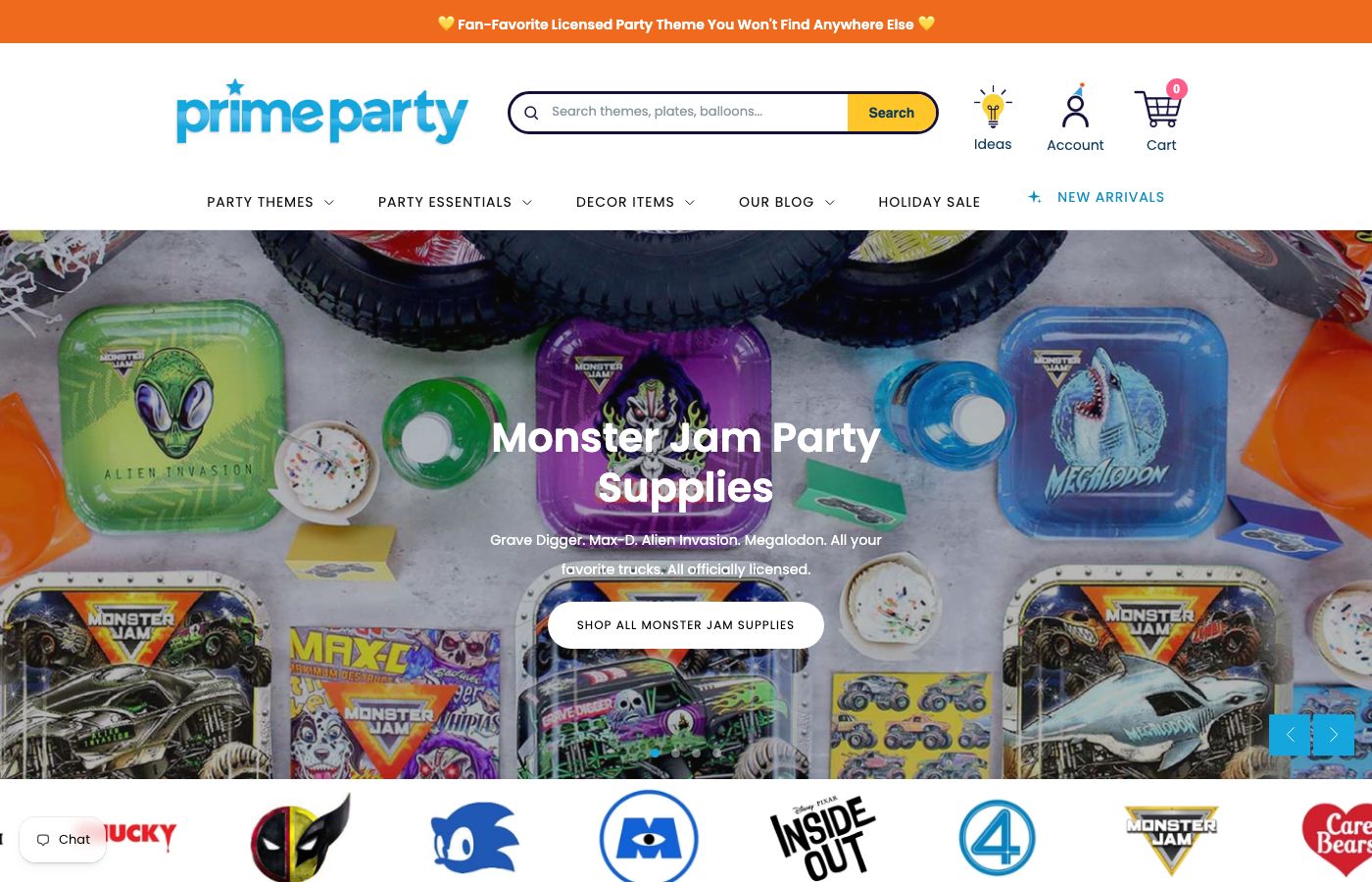
The brand.
Prime Party is a licensed party supplies retailer with a catalog that spans some of the most recognizable pop-culture properties in the world — Monster Jam, The Office, Golden Girls, Ghostbusters, Care Bears, and more. These are not generic party themes; they are officially licensed partnerships with established fan bases, people who will spend real money to celebrate the things they love.
The business had earned genuine traction. More than 755 customer reviews. Press coverage in Yahoo, New York Magazine, and Mental Floss. A product catalog broad enough to serve birthdays, bachelorettes, themed dinner parties, and everything in between. The infrastructure to license this many properties is not trivial — it signals a business with real operations, real supplier relationships, and real demand.
What they needed was a storefront capable of converting that demand at scale.
The challenge.
Licensed party supplies are a visually intense product category. Every property has its own color palette, its own iconography, its own fan expectations. A store serving Monster Jam customers and Golden Girls customers simultaneously needs to make each property feel celebrated — not diluted into a generic party supplies grid where everything looks the same.
At the same time, the shopping experience needs to be fast, organized, and easy to navigate. A customer who arrives knowing they want The Office party supplies should be able to find every relevant product quickly, understand what's in each pack, and add to cart without friction. A customer who doesn't know what they want should be able to browse by property, by occasion, or by product type and still find something they're excited about.
These two requirements — vivid brand expression per property and clean, fast navigation across a large catalog — are in tension. A store that leans too far into visual richness becomes slow and hard to navigate. A store that optimizes purely for catalog organization becomes flat and forgettable. Getting both right is the design problem.
Licensed products live or die on how well the brand moment lands. When a fan arrives looking for Golden Girls party supplies, the page needs to feel like it belongs to that world — not like a spreadsheet with images attached.
What we built.
We built the full Prime Party Shopify store from the ground up — every template, every collection, every product page. The brief was a complete e-commerce platform that could hold the energy of the licensed brands it sold while remaining navigable at scale.
The collection page architecture was the most important decision. Customers who arrive on a Prime Party Monster Jam collection page are in a very specific headspace — they are planning something specific for someone who loves that property. Every visual element on that page needs to reinforce the licensed brand they came for. We designed the collection pages to carry the energy of each property while keeping the product grid clean and scannable.
Product pages were built to answer the questions that drive hesitation in the party supplies category: exactly what is in this pack, how many people does it serve, what occasion is it designed for, and what else do I need to complete the table. A customer planning a full party needs to be able to build their cart from a single product page without opening six browser tabs.
What we did not do.
We did not recommend a platform other than Shopify. For a licensed product retailer with an established catalog, supplier integrations, and real review volume, Shopify is the right foundation — it handles the operational complexity that comes with running a licensed brand store, from inventory management to payment processing to third-party app integrations. The problem was never the platform.
We did not genericize the visual identity to make the build easier. Licensed party supplies live or die on how well the brand moment lands. Making every collection page look the same would have been faster to build and far less effective as a commerce experience. We built the flexibility in rather than taking the shortcut.
We did not scope this as a template customization. Prime Party's catalog has a specific character — vibrant, celebratory, fan-first — that no off-the-shelf Shopify theme is built to express. A ground-up build was the right call, and the result reflects that.
The result.
Prime Party now has a storefront that matches the energy of the licensed brands it carries. A customer who arrives looking for The Office party supplies lands on a page that feels like it belongs to that world — not a generic grid with a logo dropped in. That coherence between brand expectation and commerce experience is not decorative; it is a direct input to conversion rate.
The catalog is navigable at scale. More than 755 reviews represent a substantial purchase history — customers who arrived with intent and followed through. The store is built to convert that intent reliably, whether the customer arrives knowing exactly what they want or browsing for inspiration.
The press coverage — Yahoo, New York Magazine, Mental Floss — represents the kind of credibility that brings in traffic from audiences who don't already know the brand. A store that can convert first-time visitors coming from editorial coverage is a different business than one that only converts fans who already love the properties. Prime Party can do both.
A licensed product catalog is only as strong as the store it lives in. Prime Party built the supplier relationships, the brand partnerships, and the review base. We built the storefront that lets all of it convert.
What this means for your licensed brand.
If you sell licensed products — in any category — your store has a specific challenge: you need to honor the brand expectations of multiple distinct fan bases simultaneously, without making the navigation so complex that customers can't find what they came for. A generic theme built for undifferentiated products cannot do that job. It is the wrong tool for the category.
A custom Shopify build is not only for brands at the scale of your largest competitor. It is for any brand that has earned a catalog with real character and needs a store that can express it. Prime Party had 755+ reviews and editorial coverage before they had a storefront that matched. You do not need to wait to outgrow a generic theme — you can start with one that was built for your actual business.
The party supplies category is driven by occasion urgency and emotional resonance. A parent shopping for their child's birthday at 10pm needs to find the right theme fast, understand what's in the pack, and check out without friction. A store that delivers that experience wins the sale. A store that makes them work for it loses it to whoever is one click away on Google.
Your store should match what you sell.
Tell us about your catalog, your licensed properties, or your product category. We'll show you what a store built for your actual business looks like.