One platform.
190+ countries.
Zero downtime.
The problem.
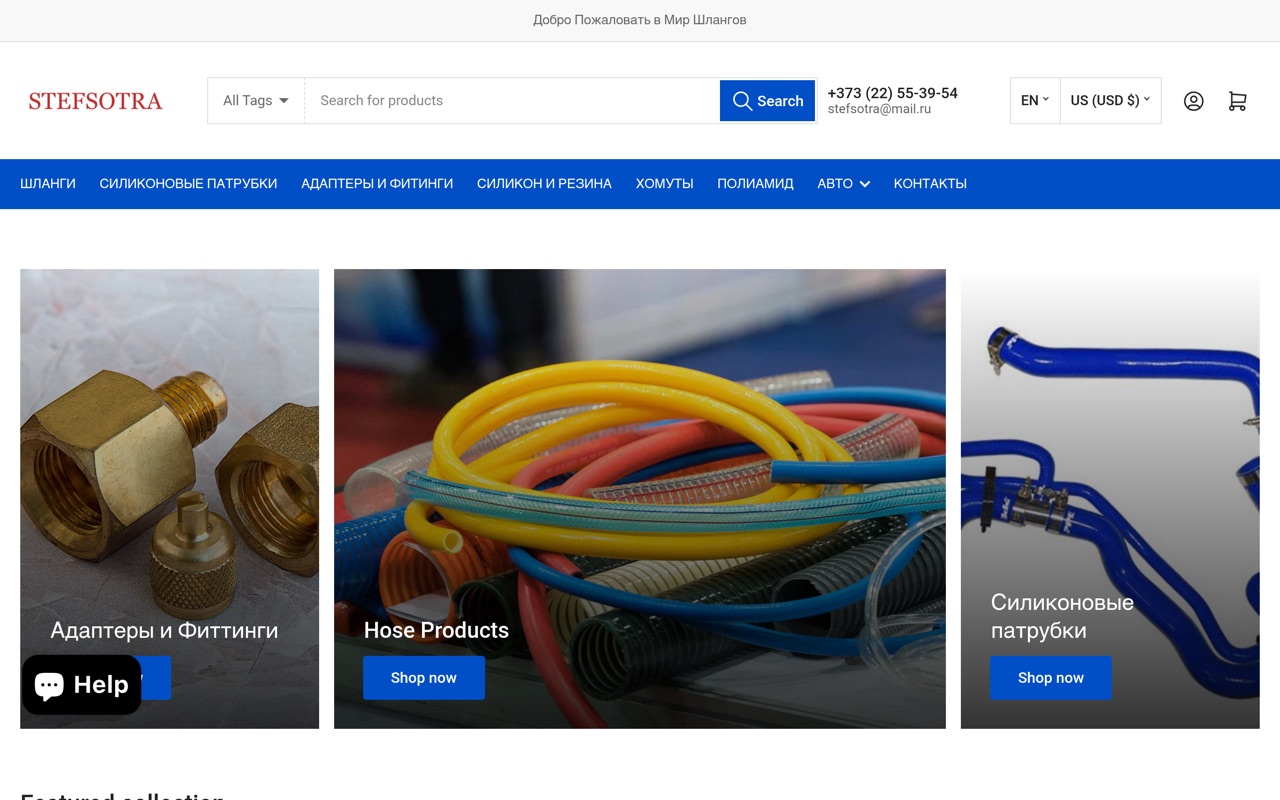
Stefsotra is a Moldovan industrial supplier operating out of Chișinău. Their product catalogue spans hoses, silicone tubing, fittings, clamps, rubber products, and automotive components — the kind of inventory that demands precision: right spec, right quantity, right price for the right customer in the right country.
When they came to us, they were running on a dated Shopify setup that was buckling under the weight of international growth. The core issues were structural. Multi-currency wasn't just a display problem — it was tangled up with country-specific tax rules that varied across their customer base. Wholesale and retail order volumes lived in the same system with no clean separation. International customers were working around the platform rather than through it.
Shopify out of the box isn't built for what Stefsotra needed. It's built for a single-currency, single-market retailer with a manageable catalogue. Stefsotra was operating in a different league: cross-border B2B transactions, bulk pricing tiers, quote-based workflows, business account management, and compliance requirements that changed country to country. The platform was a ceiling, not a foundation.
The ask was direct: rebuild it properly. Build something that can hold their international operation today and scale with it as they grow.
What we built.
We replaced the Shopify setup with a high-performance B2B/B2C e-commerce platform built from the ground up for international industrial commerce. The product catalogue was rearchitected around industrial category structure — not a generic e-commerce taxonomy, but a hierarchy that reflects how buyers in this sector actually search and specify products.
The platform was load-tested at 10× projected peak traffic before a single customer saw it. When traffic spikes arrived post-launch, the infrastructure held without incident — zero downtime, zero emergency deploys, zero customer-facing errors.
The hard parts.
Industrial B2B e-commerce has a set of requirements that consumer e-commerce tools paper over. The hard parts weren't the storefront — they were the logic underneath it.
Bulk pricing tiers sound simple until you're managing them across hundreds of SKUs with different unit economics, different minimum order quantities, and different logistics costs depending on where the order ships. We built a pricing engine that handles this without requiring a spreadsheet for every SKU update.
Quote requests are another layer of complexity. Not every order fits a standard checkout — large industrial purchases often require back-and-forth on specification, quantity, and lead time before a price is agreed. We built a quote workflow that captures these enquiries, routes them to the right person at Stefsotra, and converts them into orders without losing the thread of the negotiation.
Country-specific compliance was handled at the platform level, not bolted on. Tax rules, required documentation, and regulatory considerations were mapped for Stefsotra's primary markets and applied automatically based on shipping destination. The operations team doesn't think about this — the platform handles it.
And then there's scale. An international industrial supplier doesn't get to have downtime. A buyer in Germany who can't complete an order at 11pm on a Tuesday will go elsewhere. We built the platform with horizontal scaling in mind from the start, tested it aggressively before launch, and it's held under every traffic condition since.
What happened after launch.
The platform launched on schedule at the end of the 12-week build. The load testing proved its worth almost immediately — early traffic spikes that would have exposed a fragile system found nothing to exploit. The infrastructure absorbed them, the orders processed, and the operations team spent zero time on incident response in the weeks following launch.
Stefsotra now serves customers across 190+ countries through a single platform that handles the complexity of international industrial commerce behind the scenes. Multi-million GMV annual run rate, processed through a system that the team described as the core factor enabling their international scale.
That's not a coincidence. International expansion requires a platform that buyers in 190 countries can trust to process their order correctly, charge them the right price in their currency, and ship to their address without friction. When the platform is the bottleneck, growth stops at that bottleneck. When the platform works, the business can focus on winning customers rather than managing infrastructure.
What this means for an industrial supplier with international ambitions.
Most industrial suppliers hit the same ceiling at the same point in their growth curve. The initial setup — whether it's Shopify, WooCommerce, or a bespoke system built five years ago — works until it doesn't. The moment you're handling multi-currency, multi-language, wholesale and retail simultaneously, with country-specific compliance requirements, the cracks show fast.
The answer isn't to patch the existing setup. The answer is to build something that's designed for what you're actually doing. The Stefsotra platform is a reference point for what that looks like: a system built around the operational reality of international industrial commerce, not a consumer e-commerce template stretched to fit.
If you're an industrial supplier whose current platform is slowing down your international operation — or you're planning an international push and want to get the infrastructure right before you scale — the conversation starts with understanding your order types, your markets, and your operations. We'll tell you what makes sense and what to build toward.
Building for international scale?
Tell us about your products, your markets, and what your current platform can't handle. We'll scope what a proper solution looks like — and what it takes to build it.